

![Seikonaut Bracelet 20/16mm [TITANIUM] - - - - Lucius Atelier - Swiss Quality Seiko Watch Mod Parts](http://luciusatelier.com/cdn/shop/files/Seikonaut-Bracelet-2016mm-TITANIUM-Lucius-Atelier-Swiss-Quality-Seiko-Watch-Mod-Parts-7_1600x.jpg?v=1745004195)
![Seikonaut Bracelet 20/16mm [TITANIUM] - - - - Lucius Atelier - Swiss Quality Seiko Watch Mod Parts](http://luciusatelier.com/cdn/shop/files/Seikonaut-Bracelet-2016mm-TITANIUM-Lucius-Atelier-Swiss-Quality-Seiko-Watch-Mod-Parts-7_2000x.jpg?v=1745004195)
Three watches sit on the desk. One is a Seiko SKX007 — 42.5mm. One is a Seiko SKX013 — 38mm. One is the Lucius Atelier SKX013 Diver 38 — also 38mm. The SKX013 wears like a 36mm dress watch. The SKX013 Diver 38 punches above its 38mm class — close to the SKX007's wrist presence, on a smaller wrist footprint. Same number on the box. Three completely different watches on the wrist.
If you've ever bought a 38mm watch expecting a certain wrist presence and got something else entirely, this article explains why — with calipers, measurements, and three watches measured side-by-side. By the end you'll know exactly what to look for in any product photo, before you spend a cent.
A quick note on abbreviations used throughout this article:
- Case OD — Case Outer Diameter. The widest point of the watch case, excluding the crown. This is the "size" number on every product page.
- Bezel insert ID — Bezel Insert Inner Diameter. The inner edge of the printed bezel insert. Defines the visible dial window.
- Bezel insert OD — Bezel Insert Outer Diameter. The outer edge of the printed bezel insert.
- L2L — Lug-to-Lug. The distance across the case from lug tip to lug tip. How far the watch reaches across your wrist.

What actually controls perceived size
Case OD (Case Outer Diameter) is the marketing number. It's the headline on every product page, every spec sheet, every forum post. It also explains less of the wrist-presence story than most modders assume.
The variables that actually move the needle, ranked by impact:
- Bezel insert ID — the inner edge of the bezel insert defines the visible dial window. This is the single biggest perceptual variable.
- Case thickness — a thick case reads as a "puck" rather than a wide watch. Thinness paradoxically makes a watch look wider.
- Lug-to-lug (L2L) — how far the case reaches across the wrist. Higher L2L-to-OD ratio means more wrist coverage.
- Lug thickness at springbar — chunkier lugs add visual mass at the case edge.
- Bezel insert vs dial colour contrast — when both are the same colour, the eye reads the entire surface as "dial." A black-on-black build looks 10–15% larger than the same case with a high-contrast insert.
- Crown position — a crown at 3 o'clock extends the silhouette horizontally where the eye measures width. A 4 o'clock crown sits below that axis.


Three watches, three stories
Here are the measurements from all three cases, taken with calipers. Every dimension is in millimetres unless noted.
| Spec | SKX007 | SKX013 | SKX013 Diver 38 |
|---|---|---|---|
| Case OD (Outer Diameter) | 42.5 | 38.0 | 38.0 |
| Original bezel OD | 41.0 | 36.7 | 38.4 |
| Bezel insert OD | 38.0 | 33.7 | 35.7 |
| Bezel insert ID (Inner Diameter) | 31.5 | 27.5 | 29.2 |
| Insert ID as % of case OD | 74.1% | 72.4% | 76.8% |
| Lug-to-lug (L2L) | 46.0 | 44.6 | 46.0 |
| L2L as % of case OD | 108.2% | 117.4% | 121.1% |
| Case thickness | 13.25 | 14.5 | 10.86 |
| Lug width | 22.0 | 20.0 | 20.0 |
| Lug thickness at springbar | 3.5 | 3.0 | 2.65 |
| Crown diameter | 7.0 (OEM) | 6.0 (OEM) | 7.0 |
| Crown position | 4 o'clock | 4 o'clock | 3 o'clock |
Methodology note: the SKX013 measured here is a modded build — its bezel, bezel insert, sapphire crystal, dial, and hands have been replaced with Lucius Atelier parts. The case body, caseback, and crown are stock Seiko. The SKX007 has its bezel replaced with a pilot bezel; everything else is stock. This article is about case geometry, so the modifications don't affect any of the measurements compared.
The key concept: bezel insert ID as a percentage of case OD
Of all the numbers in the table above, this is the one that matters most for wrist presence. Here's what it means, how it's calculated, and why it predicts perceived size better than case OD alone.
What it is. The bezel insert ID is the inner edge of the printed bezel insert — the boundary where the dial becomes visible. Expressed as a percentage of case OD, it tells you what fraction of the total case width is taken up by the visible dial window, versus the bezel ring surrounding it.
How it's calculated.
Worked example — SKX013 Diver 38:
(29.2 ÷ 38.0) × 100 = 76.8%
Worked example — SKX007:
(31.5 ÷ 42.5) × 100 = 74.1%
Why it matters. The eye doesn't measure absolute millimetres at arm's length — it measures proportion. When 76.8% of a watch's width is visible dial, the eye reads that watch as "more open" — more dial showing, less bezel framing it. When only 72.4% is visible dial, the eye reads it as "more closed" — thicker bezel surround, smaller window. This proportion is what your eye actually registers as "watch size" almost regardless of the absolute case OD on the spec sheet.
The same logic applies to lug-to-lug as a percentage of case OD:
Worked example — SKX013 Diver 38:
(46.0 ÷ 38.0) × 100 = 121.1%
Worked example — SKX007:
(46.0 ÷ 42.5) × 100 = 108.2%
A higher L2L-to-OD ratio means the case reaches proportionally further across the wrist, giving a stronger "wrist-filling" impression at any given case OD.
TL;DR for those who skipped the math: a higher percentage means more dial showing through, less bezel framing it. The SKX013 Diver 38 shows 76.8% visible dial — the highest of all three watches measured here, including the 42.5mm SKX007. That's why a 38mm watch can punch above its class.
Three numbers are worth looking at twice.
Bezel insert ID as a percentage of case OD. The SKX013 Diver 38 shows 76.8% of its case OD as visible dial window. The SKX013 shows 72.4%. The SKX007, at 42.5mm case OD, shows 74.1%. The Diver 38 has the highest visible-dial ratio in the comparison — more proportional dial than even the 42.5mm SKX007 — which is why a properly engineered 38mm case can read as wide as a watch nearly 5mm larger.
Lug-to-lug as a percentage of case OD. The SKX013 Diver 38 reaches 121.1% of its case OD across the wrist. The SKX007 reaches 108.2%. Both have the same absolute lug-to-lug span (46.0mm), but the Diver 38 achieves it on a smaller case, so the proportional reach is greater. On the wrist, this means the Diver 38 covers as much wrist real estate as the SKX007 — at a smaller case footprint.
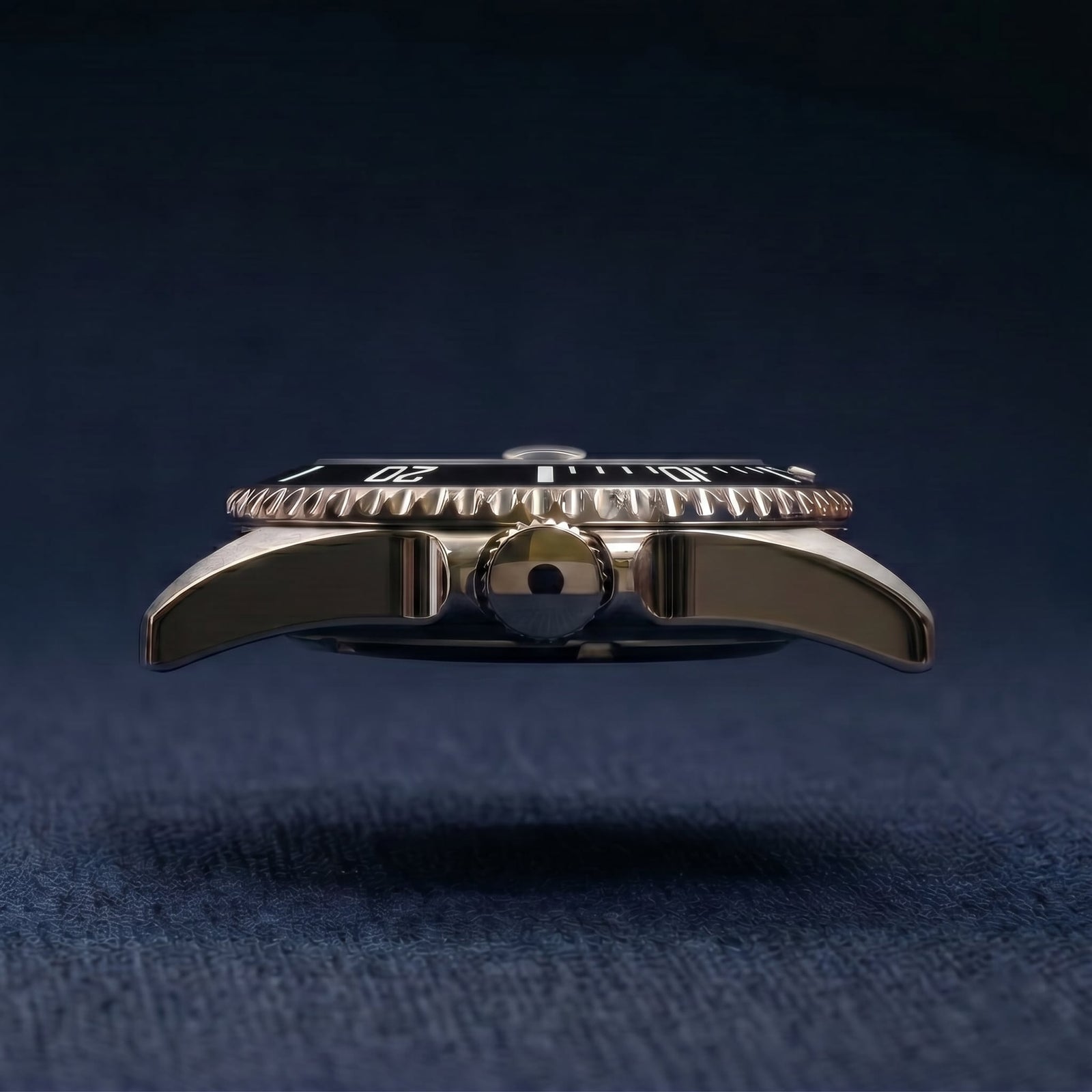
Case thickness. The SKX013 Diver 38 is 10.86mm thick. The SKX007 is 13.25mm. The modded SKX013 case is 14.5mm. Thinner cases don't look smaller — they look wider. Vertical mass competes with horizontal spread for the eye's attention. A thick case reads as a coin balanced on the wrist; a thin case reads as a watch that fills the wrist horizontally.

How they actually wear
The wrist shot is the moment of truth. Same wrist, same lighting, same angle, three watches.

The SKX007 is exactly what 42.5mm looks like on the wrist — confident, full presence, a proper diver silhouette. It's the king of "big watch" energy in this comparison, and nothing about a smaller case changes that.
What's interesting is the other two 38mm watches. The SKX013 wears noticeably smaller than its 38mm spec suggests — closer to 36mm in feel. The SKX013 Diver 38 wears noticeably bigger than its 38mm spec suggests — punching well above the SKX013 it shares a platform with, and closing most of the visual gap to the SKX007. Same case OD as the SKX013, completely different wrist presence.
The takeaway: case OD tells you one thing about a watch. Proportion tells you the other.
Six tells you can read in any product photo
You don't need to own three watches to predict how one will wear. Here are the thresholds that separate "wide presence" from "narrow presence" — readable from any decent product photo.
- Bezel insert ID above 75% of case OD reads as wide, modern presence. Below 73% reads as a thicker, more traditional dive watch silhouette. This is the dominant variable — check it first.
- Case thickness under 11mm reads as wide on the wrist. Over 13mm reads as chunky. The cutoff between the two is sharper than most modders realise.
- L2L above 120% of case OD gives you wrist-filling presence. Below 115% leaves visible wrist around the case.
- Lug thickness under 3mm at the springbar reads as elegant and modern. Above 3.5mm reads as tool-watch chunky. Both are valid — pick the silhouette you want.
- Matching bezel-and-dial colours visually merge the dial and bezel into one mass — the watch reads larger. Black-on-black, green-on-green, monochrome builds in general. High contrast separates the two zones and reads smaller.
- Crown at 3 o'clock extends the case horizontally where the eye measures width. A 4 o'clock crown tucks below that axis. Real effect, but secondary to the geometric variables above.

Engineering for wrist presence at 38mm
The SKX013 Diver 38 was designed specifically to maximise wrist presence at a 38mm case OD. Three engineering choices made this possible:
- The bezel insert window was widened to 29.2mm ID — the largest in the SKX013 platform — pushing the visible dial ratio to 76.8% of case OD.
- The case was engineered to 10.86mm thickness — significantly thinner than both the SKX007 (13.25mm) and the modded SKX013 case (14.5mm) — so the watch reads as wide rather than chunky.
- The lugs reach 46mm tip-to-tip, matching the SKX007's lug-to-lug despite a smaller case OD, for maximum proportional wrist coverage.
The result is a 38mm case that holds its own against modern 40–41mm dive watches. Smaller wrist footprint, wider visual presence. The Diver 38 launches in two variants: a Black bezel insert + Black dial build for the maximum-presence configuration, and a Green build for a softer, more nuanced dive-watch silhouette.

Ready to build a 38mm watch that punches above its class?
